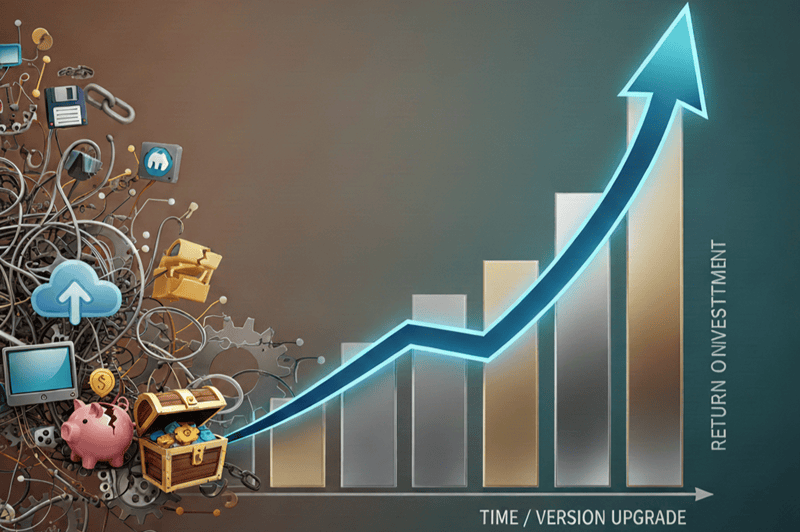
An upgrade to the latest version of Delphi isn’t just a technical task; it’s a strategic business decision that can yield a significant return on investment (ROI). By moving to the latest version, businesses can directly address the mounting costs and risks associated with maintaining outdated systems, while unlocking new opportunities for growth and innovation.
Quantifying the Tangible ROI: Cost Savings and Efficiency Gains
The most immediate and measurable benefits of a Delphi upgrade are financial. Maintaining legacy software on older versions of Delphi often leads to a higher total cost of ownership (TCO) than many organizations realize.
1.Reduced Maintenance and Support Costs:
Older versions of Delphi may be incompatible with modern operating systems and hardware, requiring developers to spend a disproportionate amount of time on workarounds and manual fixes. Upgrading to a modern version like the latest RAD Studio provides a robust framework that is compatible with current technologies, significantly reducing the time and resources spent on maintenance. This frees up developers to focus on new features instead of endless bug fixes.
2.Faster Development Cycles:
The newest versions of Delphi come with advanced features, improved IDE performance, and a massive library of components. Features like the enhanced VCL for Windows 11 and the Fire Monkey (FMX) framework for cross platform development (Windows, macOS, iOS, Android, and Linux) mean that developers can build applications 5 times faster than with other tools. This rapid application development (RAD) capability translates directly into a faster time to market for new products and features, giving businesses a competitive edge.
3.Lowered Infrastructure and Licensing Costs:
Running older software often requires maintaining outdated server environments or even physical hardware. Modern Delphi applications can be easily deployed to the cloud or on modern, more efficient infrastructure, leading to significant savings on hardware, power, and physical space. Furthermore, the latest licensing models, such as the Update Subscription, offer a predictable and cost effective way to always have access to the newest features and security patches, avoiding the expensive process of buying new licenses every few years.
Measuring the Intangible ROI: Unlocking New Business Value
- Beyond the direct cost savings, a Delphi upgrade delivers a host of strategic, though sometimes harder to quantify, benefits that drive long term business value.
- Enhanced Security and Compliance: As cyber threats evolve, older software versions become increasingly vulnerable. An upgrade to the latest Delphi version includes built in security enhancements, up to date encryption libraries, and support for modern authentication protocols. This proactive approach to security protects sensitive data, mitigates the risk of costly data breaches, and ensures compliance with industry regulations. For many businesses, a single security incident can cost millions, making this an invaluable investment.
- Improved User Experience and Customer Satisfaction: A modern application is not just about what’s under the hood. The latest Delphi versions empower developers to create visually appealing, responsive, and intuitive user interfaces. This enhanced user experience (UX) leads to higher user adoption, increased productivity for internal users, and improved satisfaction for customers. For instance, a clunky, old fashioned interface can deter new customers, while a sleek, modern one can be a key differentiator.
- Greater Scalability and Innovation: Legacy systems can become bottlenecks that hinder business growth. The newest versions of Delphi are designed for scalability, enabling applications to handle larger user bases and more complex data operations without performance degradation. With modern frameworks and component libraries, it becomes much easier to integrate with new technologies, such as cloud services, APIs, and microservices. This ability to innovate quickly allows businesses to respond to market shifts and seize new opportunities without a costly overhaul.
The Path to a Successful Upgrade: A Phased Approach
Upgrading a large scale, mission critical Delphi application can seem daunting, but it doesn’t have to be an all or nothing proposition. Many organizations find success with a phased, incremental approach.
1. Assess and Plan:
Begin with a thorough analysis of the existing application. Identify the modules that are most critical or most in need of modernization.
2.Pilot Program:
Start with a small, self contained part of the application. This allows your team to familiarize themselves with the new version, identify potential issues, and demonstrate a quick win that proves the value of the upgrade.
3.Iterative Migration:
Once the pilot is successful, you can move forward with a systematic, module by module migration. This reduces risk and allows for continuous testing and refinement.
4.Strengthen Expertise:
Don’t be afraid to utilize the vast Delphi community or partner with a specialized consulting firm. Many successful Delphi projects have utilized outside expertise to ensure a smooth transition and a successful outcome.
The ROI of a Delphi upgrade is clear and multifaceted. By moving to the latest version, businesses can move beyond simply maintaining their legacy systems and instead transform their applications into powerful, secure, and future ready assets that drive real business value.